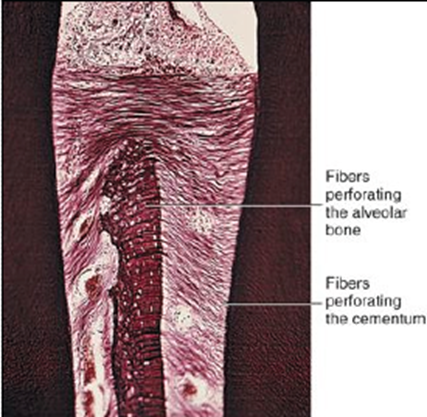
The Periodontal Ligament-A Link between the Cementum and Alveolar Bone
Michel Goldberg1*
1Department of Oral Biology, Faculty of Fundamental and Biomedical Sciences, INSERM UMR-S 1124 Paris Cite University, France
*Corresponding Author: Michel Goldberg, Department of Oral Biology, Faculty of Fundamental and Biomedical Sciences, INSERM UMR-S 1124 Paris Cite University, France; Email: mgoldod@gmail.com
Published Date: 05-03-2022
Copyright© 2022 by Goldberg M. All rights reserved. This is an open access article distributed under the terms of the Creative Commons Attribution License, which permits unrestricted use, distribution, and reproduction in any medium, provided the original author and source are credited.
| Received 24 Jan, 2021 | Accepted 26 Feb, 2022 | Published 05 Mar, 2022 |
Abstract
The Periodontal Ligament (PDL) provides support to the tooth in the bonny socket, in connecting the cementum and alveolar bone. The PDL width vary around 25 mm, including collagens and oxytalan fibers (Sharpey’s fibers). Metalloproteinases play role in the turnover of type I collagen and other matrix proteins. The PDL is implicated in bone remodeling, cells nutrition and sensory events, namely as periodontal mechanoreceptors. The PDL generates and controls tooth eruption and ensures homeostasis between fibroblasts and bone cells. The PDL form, maintain and repair this interface. After dissociation of the cells of the Hertwig’s Epithelial Root Sheath, epithelial rests of Malassez represent a unique source of stem cells population within the periodontal ligament. Extracellular matrix proteins (collagen, fibronectin and Secreted Proteins Acidic and Rich in Cysteine (SPARC), Glycosaminoglycans (GAGs) and Proteoglycans (PGs), Metalloproteinases (MMPs) and Tissue Inhibitors of Metalloproteinases (TIMP- 1 to – 4) are structural components of the PDL. This review explore:
- The attachment function of the PDL (eruption, formative and supportive functions)
- Summarize the implication of stem cells in healing, in the regulation of bone volume, PDL repair and regeneration
- Focus on the contribution of fibroblast-like and pericytes to periodontal inflammation through cytokines and chemokines and the release of molecules implicated in periodontal inflammation
- Sensory events requiring nerve corpuscles (Ruffini-like mechanoreceptors)
- Provide vascular supply and nutrients to the cementum, alveolar bone and to the PDL itself
- Because the cells of the PDL may differentiate into cementoblasts and osteoblasts, this phenotypic availability may contribute to heal the tooth supporting tissues
Keywords
Periodontal Ligament; Anchorage; Radicular Tooth; Alveolar Bone; Cementum; Collagen Fibers; Oxytalan; Matrix Metalloproteinases; Mechanoreceptors; Epithelial Rest of Malassez